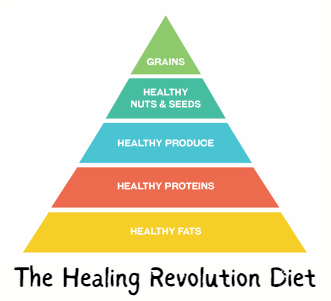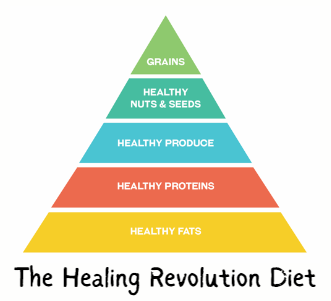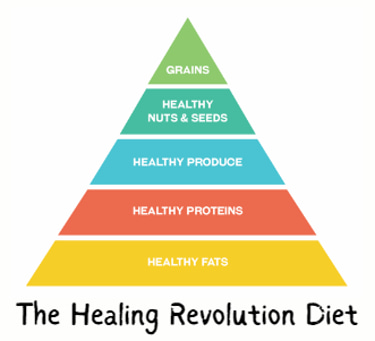
Healing Revolution Diet Food Pyramid
Between the vast amounts of ultra-processed foods, which are extremely unhealthy for us, and the recommendation that three-quarters of our diets should come from carbohydrates (or even more if you add the sugars from the recommended three cups of dairy), it is easy to understand why we have an obesity and metabolic health crisis.
The other problem with our foods is that the vast number of ingredients are produced conventionally, which means taking an efficiency and yield/profit focus over safety and nutrition.
Our conventionally grown fruits and vegetables are sprayed with multiple harmful chemicals, including pesticides and synthetic herbicides. Our conventionally raised meats are given growth hormones, antibiotics, and fed high GMO grain diets to fatten before slaughtering.
Finally, the incorrect research from the 1960s is still influencing nutrition and diet advice today – even though countless studies from this century (and in the last decade or so) have clearly shown that we’ve had nutrition guidelines upside down.
Thus, the Healing Revolution Diet Food Pyramid focuses on correcting the long-running misguided recommendations while also focusing on the importance of eating safely produced healthy foods.
One Caveat: The Healing Revolution Food Pyramid is an overall recommendation for healthy eating, but the key for you is taking these recommendations and modifying them based on how your body reacts. Your goal is finding both the healthy foods you enjoy and the best balance of those foods for your health and lifestyle.
The premise with the Healing Revolution Diet is that our foods should be providing us with maximum nutrients while reducing antinutrients to zero.
The focus here is a bit different than the standard examination of proteins, fats, and carbohydrates – the classic building blocks.
Because we do NOT need to focus on including carbs (since they exist naturally in many foods), the focus here is on these three key nutrients: fat, protein, and fiber. Underlying these three nutrients is a focus on the importance of prebiotic and probiotic foods.
Here’s how foods should be consumed throughout your day, starting with what you should be consuming the most:
Healthy Fats – 37%
Healthy Proteins – 30%
Healthy Produce – 17%
Healthy Nuts & Seeds -14%
Grains – 2%
The PURE study, which involved tracking more than 135,000 people across 18 countries and five continents for 7+ years, is a landmark study published just a few years ago; it found that people who consumed higher amounts of fat (about 35 percent of total energy consumed) had a lower risk of death compared to lower fat intake; this finding has been repeated in other studies that all show the importance of healthy fats. The key takeaway: stop eating low and no-fat products.
FYI, the PURE study also confirmed that a diet high in carbohydrates (more than 60 percent of total energy consumed) is associated with a higher risk of death.
Breaking Down the Healing Revolution Diet Food Pyramid
Let’s take a look at each category of food in the pyramid and explain both why the food is so important and identify the healthiest foods within each category.
Healthy Fats
Healthy fats are rich in nutrients and are the most essential food building block – even though fat has been demonized since the 1980s. Also, worry less about saturated versus unsaturated fats, as the myth that healthy saturated fat is bad for you has been completely debunked. Just eat lots of healthy fats.
Fats are essential to health and healing, and while many people have heeded the wrong advice of avoiding healthy saturated fats (such as coconut oil and grassfed butter), they are still eating – in record high amounts – unhealthy fats found in the popular cooking and baking oils industrially produced from the seeds of various plants (thus the name seed oils).
Fat does not make you fat. Fat from foods is not stored in the body as fat – but it was an easy lie for convincing people of the evils of fat and the bizarre no-fat and low-fat phenomenon. What does make us fat? All the refined sugars we consume excessively throughout the day, every day!
Fats are the best, slowest, and most efficient form of energy for our bodies. Fats are a key component of the cell membranes in every one of our cells, thus making it essential for body growth and development. It is vital for several body processes, from blood clotting and nervous system functioning to reproduction and immune system response.
Fats are also important for the absorption of certain key nutrients, including vitamins A, D, E, and K – all of which play important roles in maintaining healthy bones, teeth, eyes, hair, and skin.
The four healthiest fats you should be consuming daily, using in your cooking and baking, include:
Grassfed, pastured butter (ideally from a trusted local farm or commercial brands from Europe or New Zealand)
Olive oil (extra-virgin, cold-pressed – and pure)
Avocado oil
Coconut oil
You need to eliminate all the seed oils you probably are familiar with, including: soybean, vegetable, canola, corn, cottonseed, safflower, sunflower, peanut, and palm. See my article, Vegetable Oils Are Ubiquitous? Yes… and Please STOP!
Healthy Proteins
The second most important nutrient for health is protein, but the government and health organizations recommendations have gotten this one wrong too, including demonizing red meat, and making protein such a small part of the “healthy” diet.
That said, the key is for each person to find the right amount and type of protein that works for their bodies; just know that protein is an essential building block for the body. Interestingly, another benefit of protein is that it fills us the most; It helps us feel more full and satiated.
Other benefits of protein:
Helps build and maintain muscles
Good for bone health
Boosts metabolism, helping burn more calories
Can help lower blood pressure
Speeds injury recovery (because protein is the main building block of tissues and organs)
Our bodies want healthy proteins – of all types. The challenge for all of us is to find both the right types of proteins and eat them in the right amounts. Unfortunately, not all protein is healthy.
If you have ever talked with a vegan or seen pictures of chicken houses or feedlots, you should be aware of how bizarrely far afield conventional ranchers have gone in the raising of animals for human consumption.
All of these animals should be 100 percent raised on pastures. Instead, we put thousands and thousands of chickens into dark, enclosed structures and we send cattle to congested feedlots that are biohazard sites. These animals are fed food that is unhealthy and unnatural for them (GMO-grains such as corn and soy because it’s the cheapest). At the same time, these animals are also treated with antibiotics and growth hormones – all to make plumper chicken breasts and more marbled cuts of beef.
That said, the same holds for many ultra-processed forms of protein manufactured for vegans and plant-based enthusiasts. These fake meats are produced using conventionally-raised plant proteins (coated in chemical residues from the farming practices) that are put through several industrial processes, including fracking of nutrients and added chemicals to increase the food’s appeal (in terms of color, smell, taste, texture).
Healthy sources of protein include:
Eggs from pastured, free-ranging hens
Pastured, grassfed beef
Wild, free-ranging animals (including elk, bison, deer)
Pastured, free-ranging chickens and turkeys
Wild-caught fish (salmon, trout, sardines, mackerel)
Grassfed dairy
Organic quinoa
Organic tofu
Organic tempeh
Organic beans and lentils
Healthy Produce
Healthy produce includes both fruits and vegetables, though the emphasis is on vegetables. The main reason for eating these foods is the fiber, although they also include essential vitamins and minerals, as well as flavonoids, which offer excellent antioxidant and anti-inflammatory effects.
Both this and the next level of the pyramid are about the fiber. For the past 40+ years, if you have been following the standard Western diet of fast and ultra-processed imposter foods, your gut has been severely deprived of nutrients, leading to a reduction in the number and breadth of good bacteria.
I know some of you who are following a Keto or Carnivore diet might be squirming with the idea of adding some healthy carbs to your daily routine, but the evidence is clear. Yes, fiber helps against constipation (as does fat), but it’s the gut microbiome piece that is essential to living a better, healthier life.
Don’t be afraid of most vegetables, but do limit fruit consumption – and only eat whole (skin-on) fruits, with the fiber, which helps offset the added sugar.
Some of my favorite vegetables include: spinach, kale, carrots, broccoli, asparagus, sweet potatoes, garlic, and onions.
Favorite fruits include: avocados, strawberries, raspberries, blueberries, blackberries, watermelons, apples, and pomegranates.
Side note on mushrooms, which are classified as fungi, but most often found in the produce section of the store. Edible mushrooms are an amazing super food and should be part of EVERY diet; they contain health-boosting vitamins and minerals, along with protein and fiber, and have proven positive effects for both the health of the body and the brain.
Remember to buy most of your fruits and vegetables locally or organically, as conventional farming uses large amounts of toxic chemicals that leave a residue on the foods. A good rule of thumb to remember: If you are eating the entire fruit or vegetable (berries, spinach, kale), buy organic; if the food has an inedible shell or peel (bananas, avocados, watermelon), you can buy conventional because the peel protects the food inside from the contamination.
Healthy Nuts & Seeds
Healthy nuts and culinary seeds are not only amazing snacks and delicious in certain foods, they are also another excellent source of essential fiber, as well as having other nutritional benefits. (Technically, nuts are seeds, but keeping them separate since most people don’t think of nuts as seeds.)
Nuts and seeds have been in the human diet since time immemorial. Just about all our ancestors were hunters and gathers – and nuts and seeds were essential parts of their diets – and yet today, it is estimated that only a third of the population regularly consume nuts.
Nuts have a high fat content, which is of no concern because the evidence is clear that the right fat in nutritious foods is NOT a driver of fat in our bodies. We need to be consuming healthy fats.
Benefits of nuts and seeds include:
Essential fiber
Healthy fats
Nutrients, such as vitamins, magnesium, zinc, phosphorus, copper, manganese, and selenium
Antioxidants, which help combat oxidative stress and offer strong anti-inflammatory properties
Favorite nuts include macadamia, pecan, almond, pistachio, walnut, cashew.
Favorite seeds include pumpkin, chia, flax, and hemp.
Only buy raw or roasted nuts and avoid any nuts cooked in “vegetable” seed oils and any nuts sweetened with sugars.
Obviously, if you have a nut allergy, get your fiber from other sources.
Healthy Grains
Healthy grains are not a necessary component of your diet, and certainly should not be consumed anywhere near the quantity that the government and other health agencies suggest, but enjoying very small amounts of good grains occasionally should be fine for your health.
Healthy grains are whole grains, not refined. In fact, like with nuts and seeds, we have been consuming grains for many thousands of years.
Benefits of healthy grains include:
Essential fiber
High in B vitamins, including niacin, thiamine, and folate
Key minerals, including zinc, iron, magnesium, and manganese.
Antioxidants, which help combat oxidative stress and offer strong anti-inflammatory properties
Unfortunately, some people have issues with grains, including conditions such as a gluten allergy, celiac disease, or gluten sensitivity. Whether these issues stem from the change to a hybrid wheat in the U.S. or from the incredibly large amounts of synthetic herbicide used, it is still an issue that needs to be addressed.
Healthy gluten grains: wheat, rye, barley, spelt, bulgur wheat
Healthy gluten-free grains: buckwheat, sorghum, quinoa, oats, teff, amaranth
Final Thoughts on Eating Your Way to Health
The goal here is to give you a starting point, one that is much more aligned with the current research on nutrition and health than any other recommendations, many of which have just gotten it wrong – leaving us with a massive health crisis of chronic and debilitating “diseases.”